Japan, known as Nihon or Nippon (日本) in Japanese, is an island nation in East Asia. Its insular character has allowed it to develop a unique and very intricate culture, while its closeness to other ancient East Asian cultures, in particular China, has left lasting influence.
Food & everyday culture+
Japanese cuisine, renowned for its emphasis on fresh, seasonal ingredients, has taken the world by storm. The key ingredient of most meals is white rice, usually served steamed. Soybeans are a key source of protein and take many forms, notably the miso soup (味噌汁 miso shiru) served with many meals, but also tofu (豆腐 tōfu) bean curd and the ubiquitous soy sauce (醤油 shōyu).
Excerpts from Wikivoyage contributors, revision 2026-09-16. CC BY-SA 4.0. Selected excerpts; wiki formatting removed; omissions marked […]. Guide wording and any figures belong to this dated source; they do not replace the atlas statistics above. Food descriptions are not official national-dish designations.
Ratio = comparison country's source area ÷ Japan's source area; rounded to two decimals. Rankings use competition ranks (ties share a rank). Area values use the pinned geographic snapshot, not a population observation year.
Land neighbours
Land neighbours in this atlas: none. This follows the source-listed borders.
Source-listed time zones
UTC+09:00
Static source offsets, not a live clock or daylight-saving calculation. Source ↗
Computed from the atlas snapshot retrieved September 26, 2026. Population rank excludes the one country without 2024 data; no claim of an all-territory global ranking.
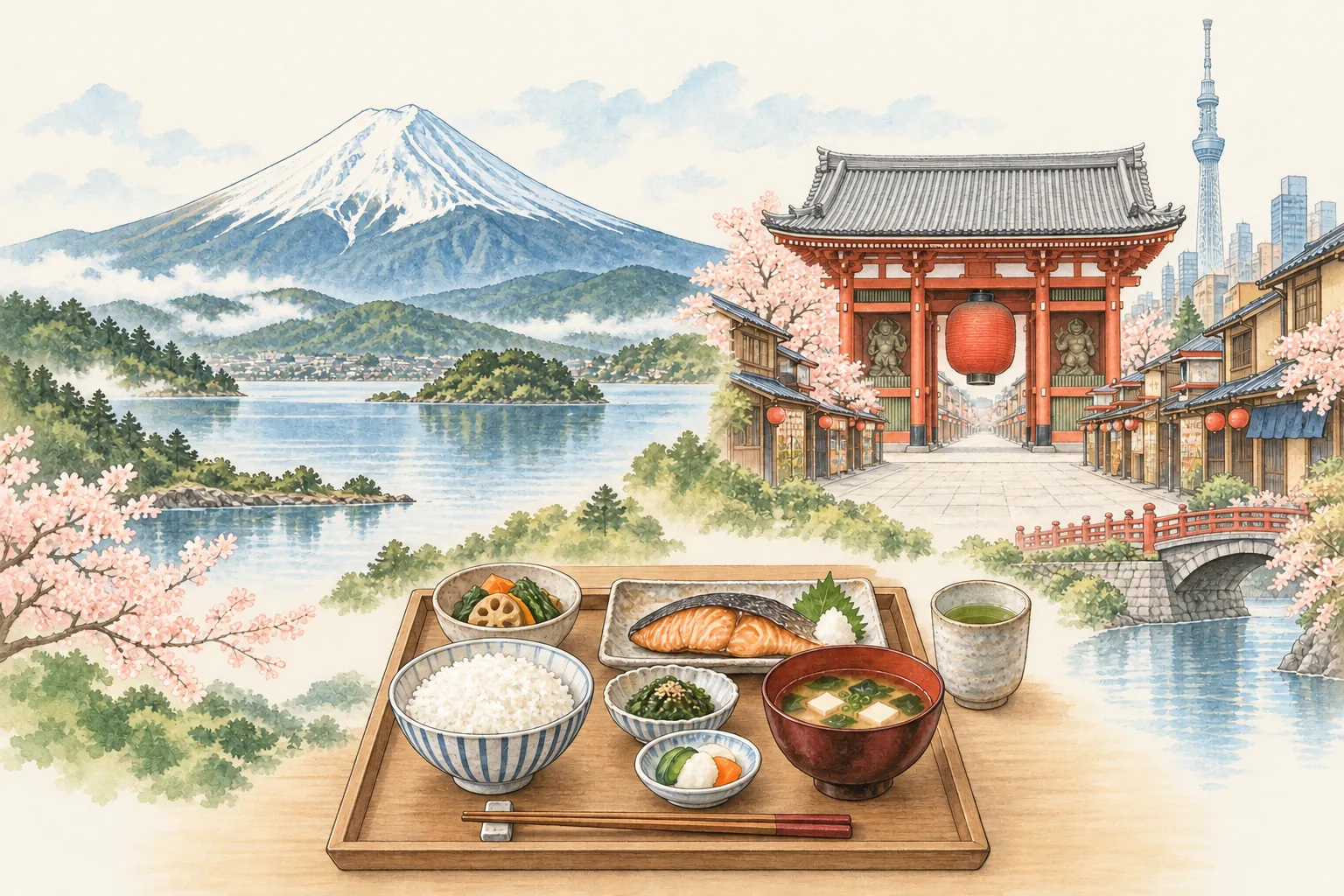
AI-generated illustrative artwork. These composite scenes are not maps, photographs or exact viewpoints. Facts come from the linked sources; the pictures are not evidence.
A little journey through Japan +
Follow three threads through Japan: the mountain that inspired generations of artists, a Tokyo neighbourhood shaped by temple and river, and a table that changes with the seasons. This illustrated collage brings separate places together for exploration.
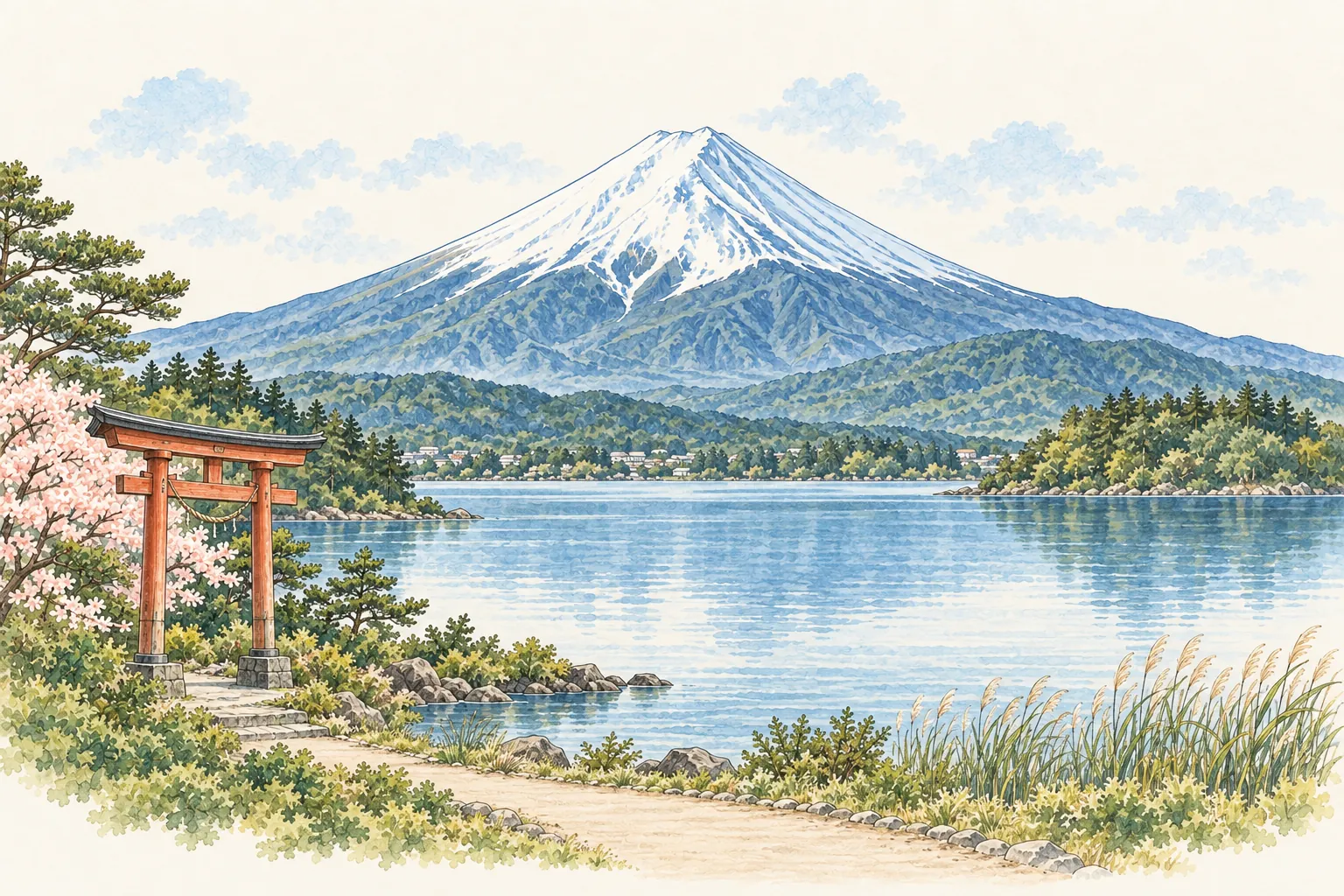
Mount Fuji rises above lakes, forests and settlements, but its story reaches beyond its volcanic outline. Pilgrims travelled between shrines and summit, while artists carried its image far beyond Japan. Explore the mountain as both a landscape and a cultural landmark.
UNESCO records Fuji as a 3,776-metre stratovolcano. Its recognisable cone is part of a wider landscape that includes lakes, springs and volcanic formations. UNESCO — Fujisan ↗
Paths of pilgrimage
The World Heritage property includes pilgrimage routes, shrines and former pilgrim lodgings. Together, these places show how worship connected the mountain with communities around its base. UNESCO — Fujisan ↗
A mountain in print
Nineteenth-century woodblock prints by Hokusai and Hiroshige helped spread Fuji’s image internationally. The mountain’s outline became a subject with an influence far beyond its slopes. UNESCO — Fujisan ↗
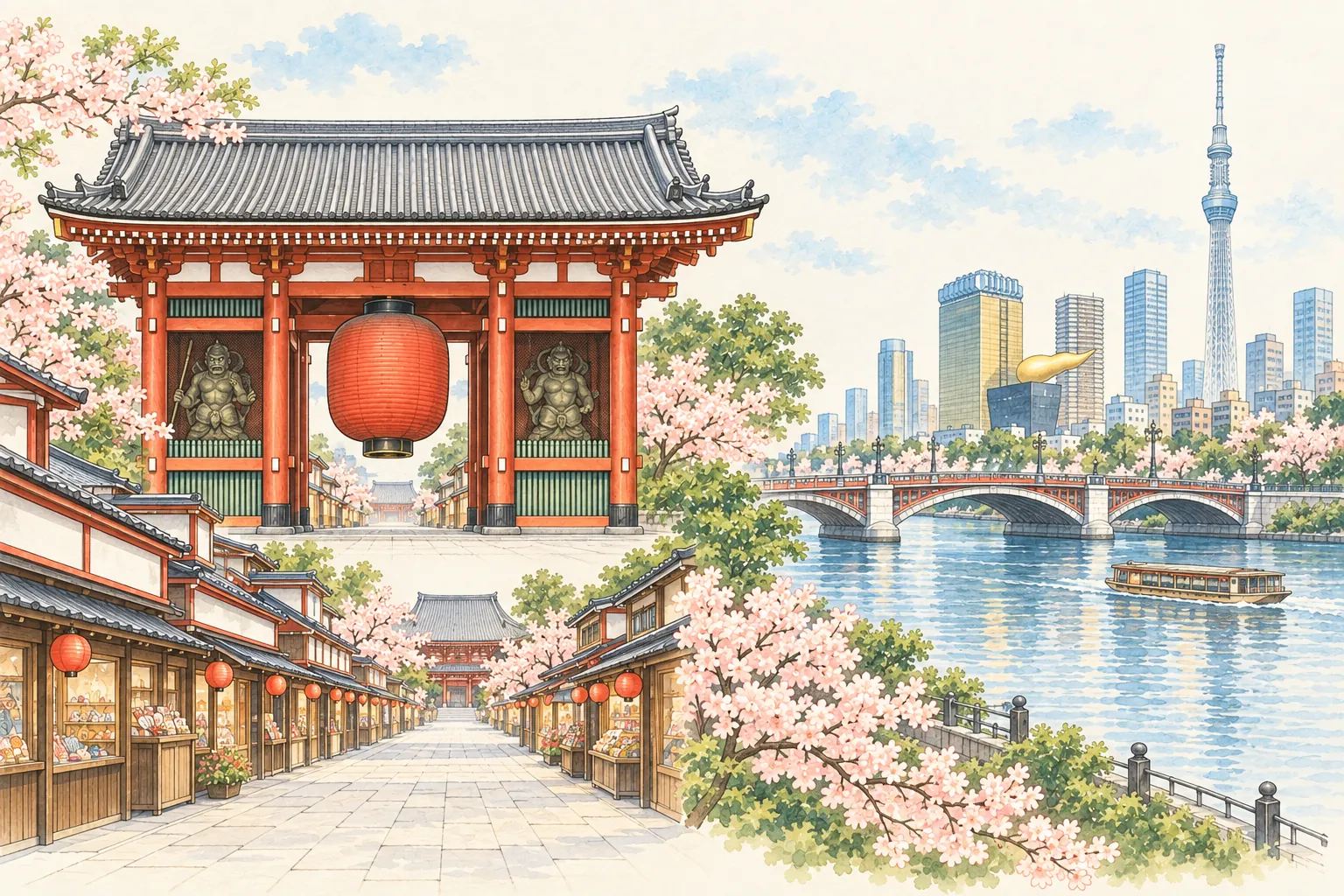
In Asakusa, Tokyo unfolds at the scale of a gate, a shopfront and a riverbank. The neighbourhood gathers around Sensoji Temple, with Nakamise’s shops along the approach and the Sumida River nearby. These are three details of one district, rather than a portrait of all Tokyo.
Kaminarimon means Thunder Gate. It marks the familiar entrance to Nakamise and the approach to Sensoji, the temple at the centre of Asakusa. GO TOKYO — Asakusa ↗
Nakamise’s small shops
Nakamise links Kaminarimon with Sensoji’s Hozomon Gate. Its shopfronts bring together snacks, souvenirs and traditional goods along a street associated with the temple approach. GO TOKYO — Nakamise ↗
The Sumida River
Asakusa sits beside the Sumida River. Its waterfront opens a different view of the neighbourhood, with bridges and landmarks along both riverbanks. GO TOKYO — Asakusa ↗
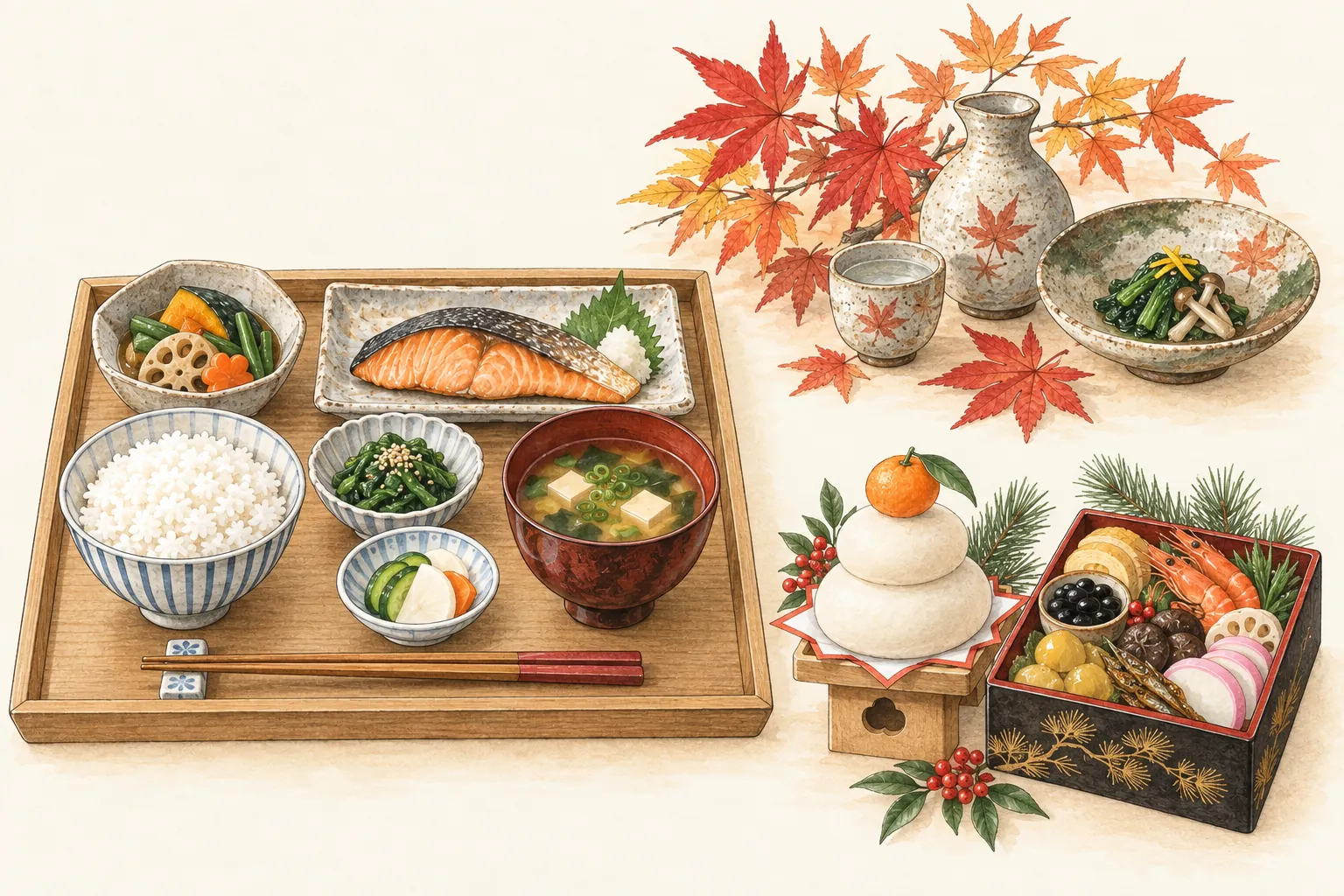
Washoku is a food culture built around ingredients, preparation and shared meals. Rice often anchors the table, while side dishes and presentation reflect place and season. This illustrative meal is one possible arrangement, not a fixed menu eaten by everyone in Japan.
Ichiju sansai describes rice accompanied by one soup and three dishes: a main dish and two sides. Rice and pickles are not counted among those three. MAFF / Taste of Japan — Rice and washoku ↗
The season on a plate
Seasonality appears in ingredients, but also in presentation. Leaves, flowers and tableware can echo the time of year as part of washoku’s attention to nature. MAFF — The four characteristics of washoku culture ↗
Food shared at New Year
UNESCO highlights New Year celebrations within washoku. Special dishes and rice cakes carry meanings, while preparing and sharing them passes knowledge between generations. UNESCO — Washoku ↗